Hue Bridge Not Found on iPhone: Is It on Your Network?
Short version. The Hue Bridge has no Wi-Fi. It is Ethernet only, so it sits on whatever subnet the router port you plugged it into belongs to, and if your iPhone is on a guest or IoT SSID it cannot reach the bridge no matter how close you stand. Two checks settle it: PingKit's Bonjour Browser for iPhone shows whether _hue._tcp is being advertised on the network your phone is on, and a scan from the LAN Scanner for iPhone finds the bridge by address and types it as a Sensor/Hub with a Philips label. Then ping it to confirm it is reachable.
The Bonjour Browser, the LAN scan and Ping are free, with all 19 tools. No ads, no account.
The One Fact That Explains Most of These
A Philips Hue Bridge connects by Ethernet. There is no Wi-Fi radio in it. That single fact accounts for the majority of "no bridge found" reports, because it means the bridge's network is decided entirely by which port you plugged it into, and your phone's network is decided by which SSID it joined. Those two can easily be different networks in the same house:
- The phone is on a guest SSID and the bridge is on the main LAN. Guest networks isolate clients by design.
- The phone is on an IoT SSID that the router keeps on a separate subnet, and the bridge is on the main one, or the other way round.
- The bridge is plugged into a mesh node or a switch behind a second router that hands out its own addresses.
In all three cases the Hue app cannot find the bridge, everything else on the phone works perfectly, and nothing you do to the bridge will help.
Step 1: Is the Bridge Advertising?
Open PingKit, go to the Tools tab and open Bonjour Browser. It browses 37 service types for fifteen seconds and groups the rows by type under friendly names rather than raw service types, so scroll to the heading Philips Hue, which is _hue._tcp.
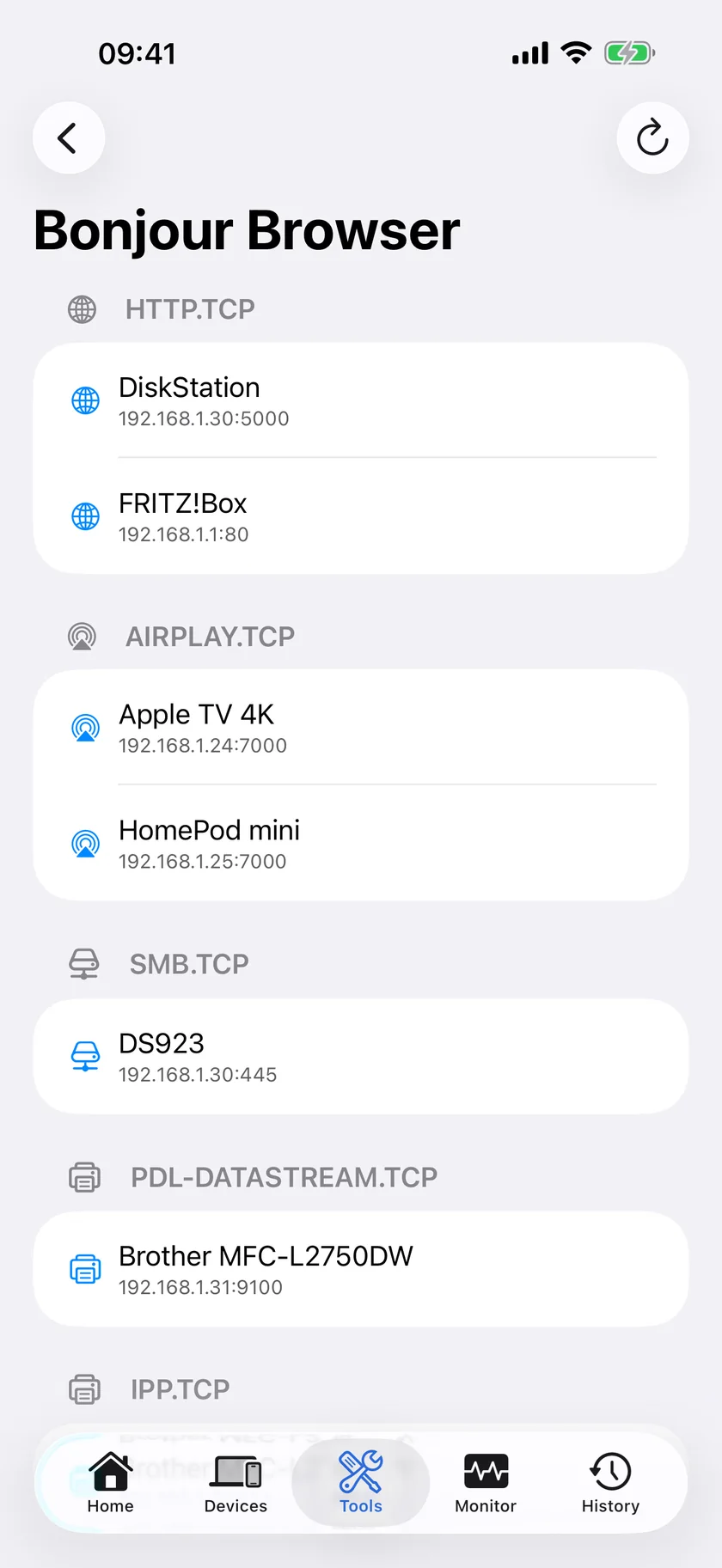
- The bridge is listed. It is on the same network as your phone and advertising itself. The Hue app should find it, so the problem is in the app: force-quit and reopen it, and check that it has local network permission in iOS Settings, which is separate from Wi-Fi access and is a common cause of an app that cannot see a device the network can.
- Nothing is listed at all. Multicast is not reaching your phone. Go to step 2.
- Other devices are listed but the bridge is not. Either it is on a different subnet, or it is not on the network. Go to step 2, then step 3.
The Bonjour Browser, the LAN scan and Ping are free in PingKit, with no account and no ads.
Step 2: Compare the Two Networks
Open My Network in PingKit and read the gateway and your own local address. Then look at the bridge: the row of three status lights on the front tells you what it believes about its own state, and all three on means power, network and cloud are all up. The large round element is the push-link button, not a status light.
| What you see | What it means |
|---|---|
| Gateway you do not recognise | The phone is on a guest network, an IoT SSID, or an extender with its own DHCP. Rejoin the main network and try again |
| Main gateway, but the bridge's middle light is off | The bridge has no network. Check the cable and the port, and try a different port on the router |
| Main gateway, all three bridge lights on, still no bridge in Bonjour | The bridge is on a different subnet from the phone even though both are on your equipment. Check what its Ethernet cable is actually plugged into |
Turn off any VPN on the phone before concluding anything: a VPN profile can capture local traffic and break discovery entirely.
Step 3: Find It by Address
Open the Devices tab, which scans as it appears; the circular arrow at the top right runs it again. The scan sweeps the subnet and lists what answers, without needing the bridge to advertise anything. A Hue Bridge that answers is typed Sensor/Hub under the IoT category, usually with a Philips label taken from what it publishes about itself. It is worth knowing the app calls it that rather than "Hue Bridge", so you are looking for the right row.
- It answers the scan but was absent from the Bonjour Browser. It is on the network and has stopped advertising. Power cycle it, and open its address in a browser: a working bridge serves a page there.
- It does not answer the scan. It is not on this subnet. That is the cabling question from step 2.
- You want to confirm reachability. Open Ping in the Tools tab and send packets to the bridge's address. Replies mean the path is fine and the fault is discovery or the app; timeouts mean the bridge is not reachable from where your phone is.
Give the bridge a reserved address in the router once you have found it. A bridge that changes address breaks every saved integration that pointed at the old one: How to Set a Static IP Address on Your Home Network.
Ask PingKit Instead
In PingKit 3.0 you can ask the assistant whether a device is on the network. Where a measurement would answer the question it offers to run one, a browse of the advertised services or a scan of your own network. Nothing runs until you tap to allow it, and the assistant cannot be handed a target: the actions it can offer are a fixed list, and a scan or a browse of your own network is on it. On a scan you have already run, Explain This Result turns the list into a sentence, on a button rather than automatically.
When the Bridge Drops Off Repeatedly
A bridge that disappears every few days is usually a DHCP lease or a flaky port rather than the bridge itself. Watching for it is not something an iPhone can do, because iOS does not let an app keep looking while it is closed. The free PingKit Agent for Mac scans every five minutes on mains power, every fifteen on battery, keeps first-seen and last-seen times, and marks a device offline after fifteen minutes unseen. Device Offline alerts are off by default: turn the Device Offline toggle on in the Agent's Settings under Device Alerts and, until the next Agent update, set Offline scans before alert, one section below under Alert Debouncing, to 1. With PingKit Guardian, that alert and that history reach the iPhone. The alert reaches the iPhone through your own private iCloud, which is one hop and best effort rather than instant.
Honest Limits
- PingKit does not control lights, pair with a bridge, or talk to the Hue API. It answers whether the bridge is present, advertising and reachable.
- The Bonjour Browser shows what reaches your phone, so a network that filters multicast makes it empty even when everything works.
- Guest networks and client isolation are router settings and cannot be worked around from an app.
- The scan types the bridge as a Sensor/Hub under IoT rather than by product name, which is what its row will say.
- Nothing on the iPhone watches for the bridge leaving while the app is closed. That needs the Mac Agent.
Frequently Asked Questions
Why does the Hue app say no bridge found?
Most often because the phone and the bridge are on different networks. The bridge is Ethernet only, so it lives on whatever subnet its router port belongs to, and a phone on a guest or IoT SSID cannot reach it. Check the gateway your phone is using and look for the section headed Philips Hue in PingKit's Bonjour Browser.
Does the Hue Bridge work over WiFi?
No. The bridge has no Wi-Fi radio and must be connected to the router by Ethernet. Only the bulbs and accessories are wireless, and they use Zigbee rather than Wi-Fi.
How do I find my Hue Bridge's IP address from an iPhone?
Open the Devices tab in PingKit, which scans as it appears. The bridge is typed as a Sensor/Hub under IoT, usually with a Philips label. You can also open the address in a browser to confirm it is the bridge, since a working bridge serves a page there.
The bridge has all three lights on but nothing finds it. What now?
All three lights mean the bridge has power, a network and a cloud connection, so it is working and your phone is somewhere else. Compare the gateway your phone is on against what the bridge's Ethernet cable is plugged into; a mesh node or a second router with its own DHCP is the usual answer.
Should I give the Hue Bridge a static IP?
A DHCP reservation in the router, yes. It does not affect discovery, which works by advertisement, but it stops the address changing under any integration that was pointed at the old one.
Find out where the bridge actually is.
Free to download, with all 19 tools and no ads. Guardian is $2.99 a month or $24.99 a year, with a 1-week free trial. Cancel anytime.
Download PingKit for iPhone